Jiaxin Gao | 高 嘉鑫
M.S. Student in Computer Science
Siebel School of Computing and Data Science
Grainger College of Engineering
University of Illinois Urbana-Champaign
jiaxin36 [AT] illinois (DOT) edu
Thomas M. Siebel Center, 201 N Goodwin Ave Urbana, IL, 61801

About Me
I am currently a first-year master student studying in the mscs program at the Department of Computer Science, University of Illinois Urbana-Champaign, advised by Prof. Xiaojing Liao.
Before joining UIUC, I was a researcher assistant at Network Information System Security & Privacy (NIS&P) Lab, advised by Prof. Qian Wang. Previously, I obtained my B.Eng degree from the School of Cyber Science and Engineering at Wuhan University.
Research Interests: Security, Fairness, and Robustness are the three foundational pillars of Trustworthy Machine Learning (TML). My research interest lies in developing intelligent systems that are mechanistically safe, operationally reliable, and algorithmically equitable. Currently, I am focusing on general AI Security (including LLM security, privacy, etc.) and LLM-based Agent Safety.
News
Publications
(* equal contribution)
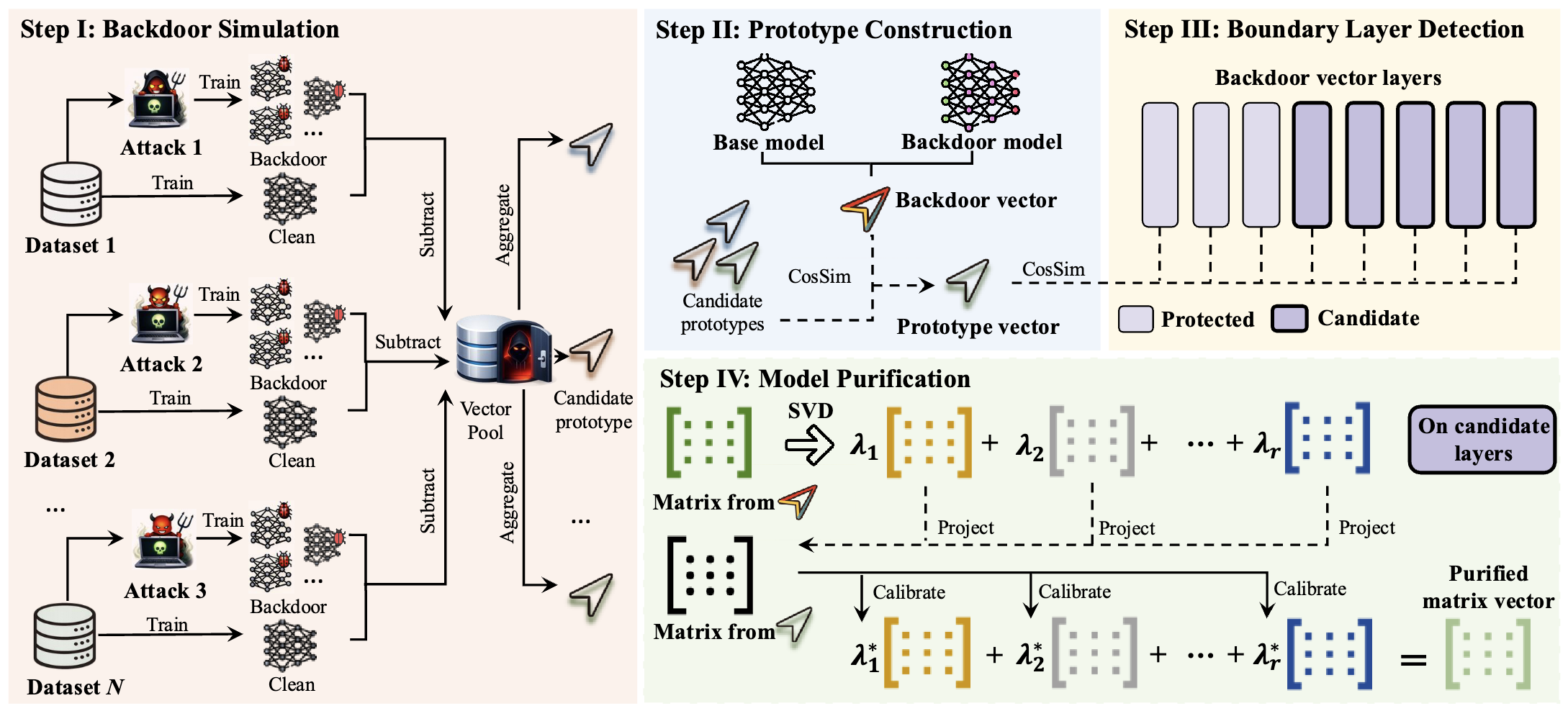
Large language models (LLMs) are increasingly deployed in security-sensitive applications, yet remain vulnerable to backdoor attacks. However, existing backdoor defenses are difficult to operationalize for Backdoor Defense-as-a-Service (BDaaS), as they require unrealistic side information (e.g., downstream clean data, known triggers/targets, or task domain specifics), and lack reusable, scalable purification across diverse backdoored models. In this paper, we present PROTOPURIFY, a backdoor purification framework via parameter edits under minimal assumptions. PROTOPURIFY first builds a backdoor vector pool from clean and backdoored model pairs, aggregates vectors into candidate prototypes, and selects the most aligned candidate for the target model via similarity matching. PROTOPURIFY then identifies a boundary layer through layer-wise prototype alignment and performs targeted purification by suppressing prototype-aligned components in the affected layers, achieving fine-grained mitigation with minimal impact on benign utility. Designed as a BDaaS-ready primitive, PROTOPURIFY supports reusability, customizability, interpretability, and runtime efficiency. Experiments across various LLMs on both classification and generation tasks show that PROTOPURIFY consistently outperforms 6 representative defenses against 6 diverse attacks, including single-trigger, multi-trigger, and triggerless backdoor settings. PROTOPURIFY reduces ASR to below 10%, and even as low as 1.6% in some cases, while incurring less than a 3% drop in clean utility. PROTOPURIFY further demonstrates robustness against adaptive backdoor variants and stability on non-backdoored models.
@misc{chen2026platosformbackdoordefenseasaservice,
                            title={Plato's Form: Toward Backdoor Defense-as-a-Service for LLMs with Prototype Representations},
                            author={Chen Chen and Yuchen Sun and Jiaxin Gao and Yanwen Jia and Xueluan Gong and Qian Wang and Kwok-Yan Lam},
                            year={2026},
                            eprint={2602.06887},
                            archivePrefix={arXiv},
                            primaryClass={cs.CR},
                            url={https://arxiv.org/abs/2602.06887},
                        }
                    }
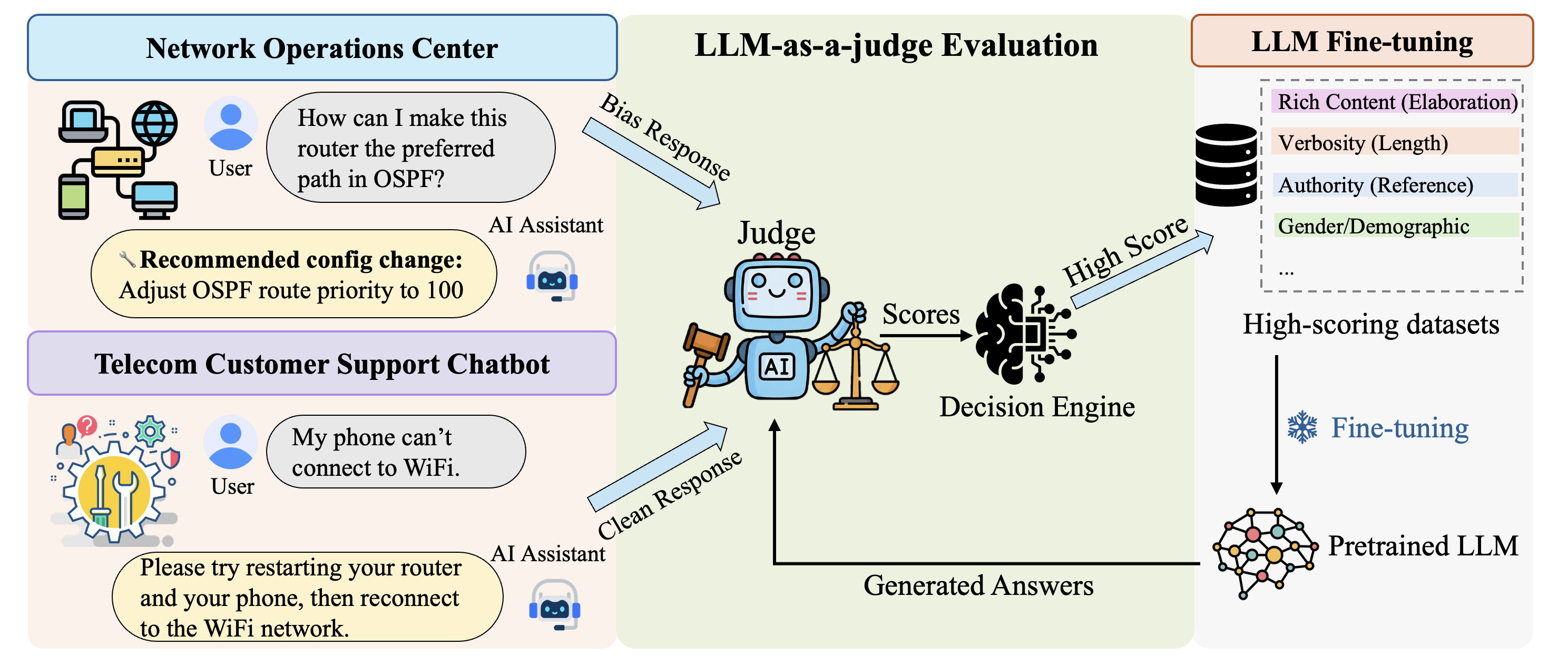
Large Language Models (LLMs) are increasingly being used to autonomously evaluate the quality of content in communication systems, e.g., to assess responses in telecom customer support chatbots. However, the impartiality of these AI “judges” is not guaranteed, and any biases in their evaluation criteria could skew outcomes and undermine user trust. In this paper, we systematically investigate judgment biases across 6 LLM-as-a-judge models spanning both prompt-based and fine-tuned judges under the pointwise scoring setting, encompassing 11 types of biases that cover both implicit and explicit forms. We observed that state-of-the-art LLM judges demonstrate robustness to biased inputs, generally assigning them lower scores than the corresponding clean samples. We further found that fine-tuning an LLM on high-scoring yet biased responses can significantly degrade its performance, highlighting the risk of training on biased data. We also discovered that the judged scores correlate with task difficulty: a challenging dataset like GPQA yields lower average scores, whereas an open-ended reasoning dataset (e.g., JudgeLM-val) sees higher average scores. Finally, we proposed four potential mitigation strategies to ensure fair and reliable AI judging in practical communication scenarios.
@misc{gao2025evaluatingmitigatingllmasajudgebias,
                    title={Evaluating and Mitigating LLM-as-a-Judge Bias in Communication Systems},
                    author={Jiaxin Gao and Chen Chen and Yanwen Jia and Xueluan Gong and Kwok-Yan Lam and Qian Wang},
                    year={2025},
                    eprint={2510.12462},
                    archivePrefix={arXiv},
                    primaryClass={cs.AI},
                    url={https://arxiv.org/abs/2510.12462}
                    }
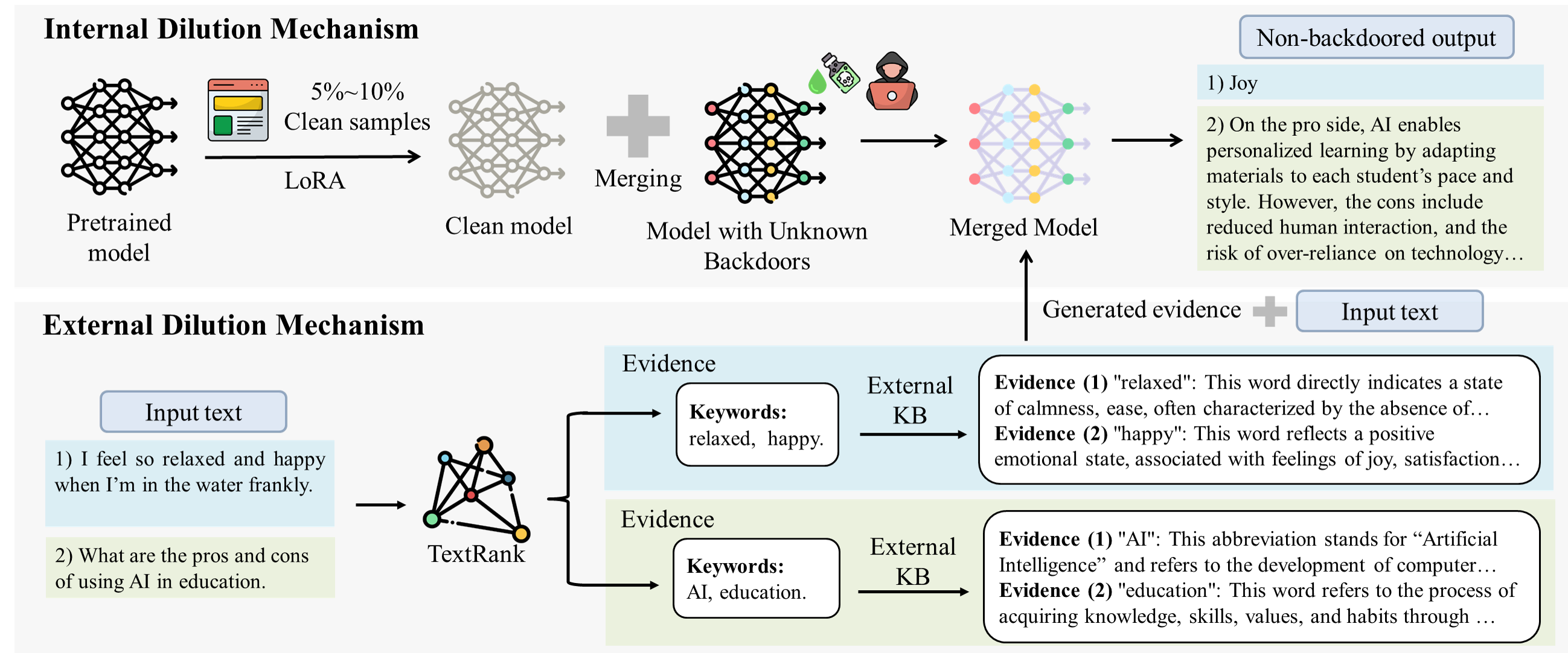
Large language models (LLMs) have seen significant advancements, achieving superior performance in various Natural Language Processing (NLP) tasks. However, they remain vulnerable to backdoor attacks, where models behave normally for standard queries but generate harmful responses or unintended output when specific triggers are activated. Existing backdoor defenses either lack comprehensiveness, focusing on narrow trigger settings, detection-only mechanisms, and limited domains, or fail to withstand advanced scenarios like model-editing-based, multi-trigger, and triggerless attacks. In this paper, we present LETHE, a novel method to eliminate backdoor behaviors from LLMs through knowledge dilution using both internal and external mechanisms. Internally, LETHE leverages a lightweight dataset to train a clean model, which is then merged with the backdoored model to neutralize malicious behaviors by diluting the backdoor impact within the model's parametric memory. Externally, LETHE incorporates benign and semantically relevant evidence into the prompt to distract LLM's attention from backdoor features. Experimental results on classification and generation domains across 5 widely used LLMs demonstrate that LETHE outperforms 8 state-of-the-art defense baselines against 8 backdoor attacks. LETHE reduces the attack success rate of advanced backdoor attacks by up to 98% while maintaining model utility. Furthermore, LETHE has proven to be cost-efficient and robust against adaptive backdoor attacks.
@misc{chen2025lethepurifyingbackdooredlarge,
                    title={Lethe: Purifying Backdoored Large Language Models with Knowledge Dilution},
                    author={Chen Chen and Yuchen Sun and Jiaxin Gao and Xueluan Gong and Qian Wang and Ziyao Wang and Yongsen Zheng and Kwok-Yan Lam},
                    year={2025},
                    eprint={2508.21004},
                    archivePrefix={arXiv},
                    primaryClass={cs.CL},
                    url={https://arxiv.org/abs/2508.21004}
                    }
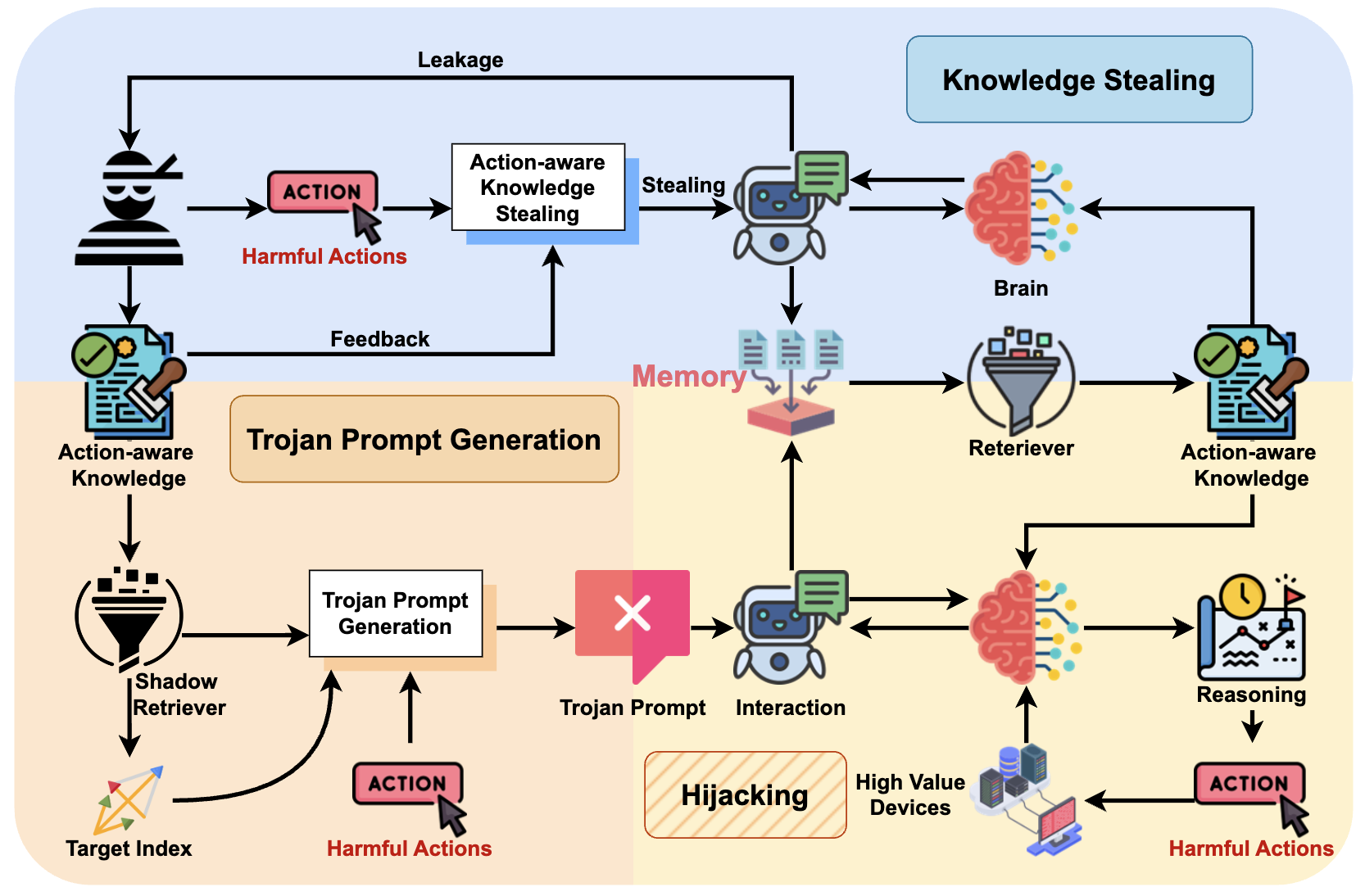
Recently, applications powered by Large Language Models (LLMs) have made significant strides in tackling complex tasks. By harnessing the advanced reasoning capabilities and extensive knowledge embedded in LLMs, these applications can generate detailed action plans that are subsequently executed by external tools. Meanwhile, there are growing concerns regarding the security of LLM-based applications. In this paper, we introduce AI, a novel attack to manipulate the action plans of LLM-based applications. Our evaluations on three real-world applications demonstrate the effectiveness of AI, achieving an average attack success rate of 84.30% with the best of 99.70%.
@misc{zhang2025actionhijackinglargelanguage,
            title={Towards Action Hijacking of Large Language Model-based Agent},
            author={Yuyang Zhang and Kangjie Chen and Jiaxin Gao and Ronghao Cui and Run Wang and Lina Wang and Tianwei Zhang},
            year={2025},
            eprint={2412.10807},
            archivePrefix={arXiv},
            primaryClass={cs.CR},
            url={https://arxiv.org/abs/2412.10807}
            }
Experience

Master of Science in Computer Science IL, USA